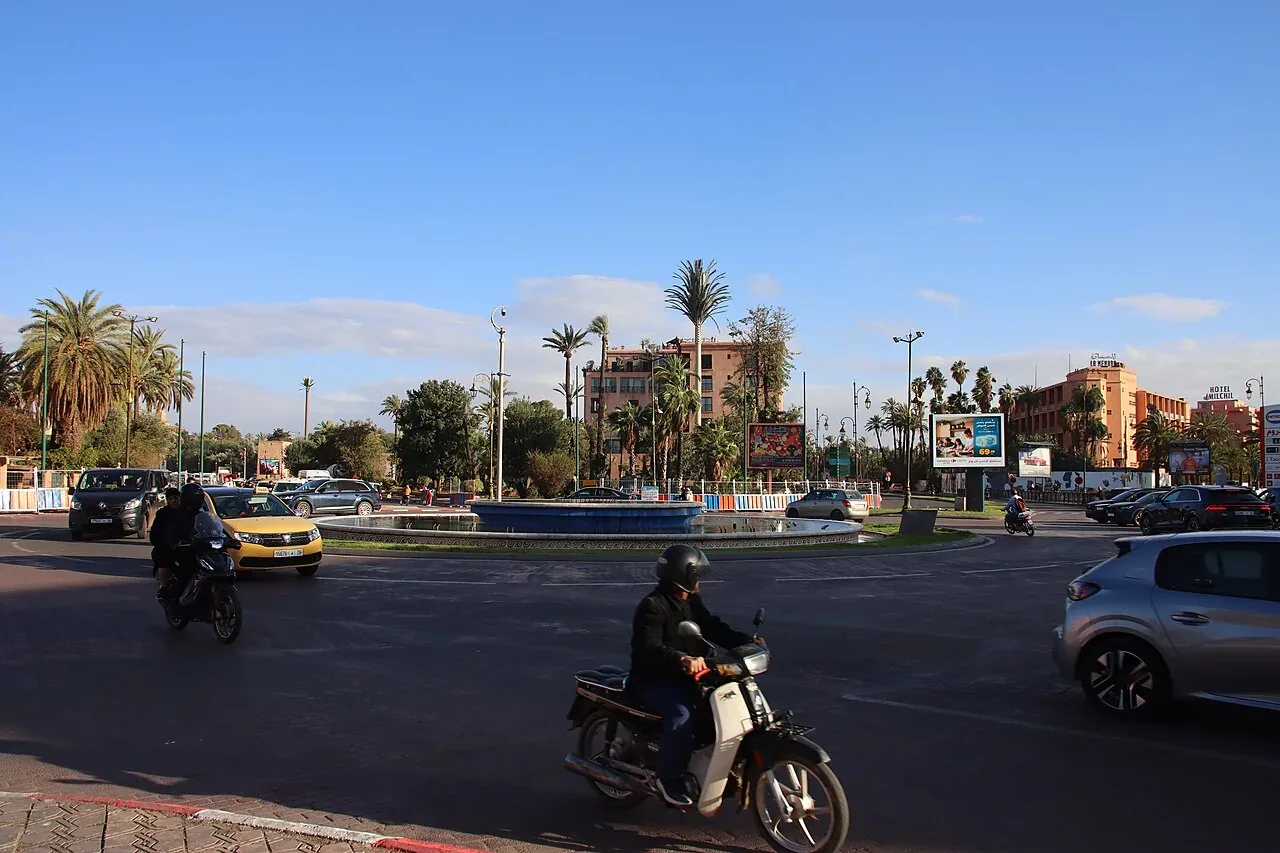
Give Guéliz a half day if you want to see how Marrakech grew beyond its ramparts. Start with the boulevards and public spaces near Place du 16 Novembre, look for the traces of twentieth-century planning, and end at Jardin Majorelle if you have booked a slot. The walk makes most sense in that order unless your garden ticket is early. For a shorter outing, choose either the station and park or the garden and museum.
Last reviewed: November 25, 2026.
Short answer: Give Guéliz 3–4 hours for a walk and one paid visit. Start at Place du 16 Novembre. If Majorelle is your priority, the garden's standard admission is 170 MAD on its official site and tickets are sold online. Allow a separate block if you also want the Yves Saint Laurent museum.
- Location Outside the medina, along Avenue Mohammed V and the avenues around Place du 16 Novembre
- New town The national tourism office dates the new town's construction to 1913
- Time A half day with one paid stop, longer for the museum and garden together
- Costs Streets and outdoor viewpoints are free to explore. The garden and museums have separate ticket rules
- Best starting point Place du 16 Novembre, or the station if you arrive by train
What Guéliz is and what to look for
Guéliz, often typed Gueliz, is the obvious name to put on your map when you want Marrakech beyond its old city. Its broad avenues, roundabouts and shopfronts offer a different way to read the city. The Moroccan National Tourist Office dates the construction of the new town to 1913 during the French Protectorate. That history is part of the street plan, and daily life around the plan has kept changing.
The Fondation Guéliz documents surviving villas, apartment buildings and cinemas. Some details are easy to miss at shop level. Look up for rounded balconies, lines of small windows and changes of building height. A useful comparison is between a broad avenue and a side street on the same walk. Neither tells the whole story on its own.
- 1913 The national tourist office dates the construction of the new town to this year.
- 1920s–early 1930s The Fondation Guéliz identifies Art Deco as an important strand of the district's architecture in this period.
- 1931 Jacques Majorelle commissions an Art Deco studio from architect Paul Sinoir in the garden area.
- 1947 Majorelle opens the garden to the public.
- 1980 Yves Saint Laurent and Pierre Bergé buy the garden and preserve it.
- 2017 The Yves Saint Laurent museum opens on the street next to the garden.
Map and boundaries
Use three separate pins: Place du 16 Novembre for the main avenue, Gare de Marrakech for the railway and theatre end, and Jardin Majorelle for the garden end.
For this walk Guéliz means the visitor-friendly stretch outside the old walls. The garden belongs on the same outing, even if a map puts its pin outside the district boundary you expected. Start with the stop you have a fixed time for, then cross the main avenues at marked crossings. Keep the orientation map with your hotel or station pin, especially if you intend to finish in the medina.
Five stops that make a good Guéliz walk
1. Place du 16 Novembre and Avenue Mohammed V
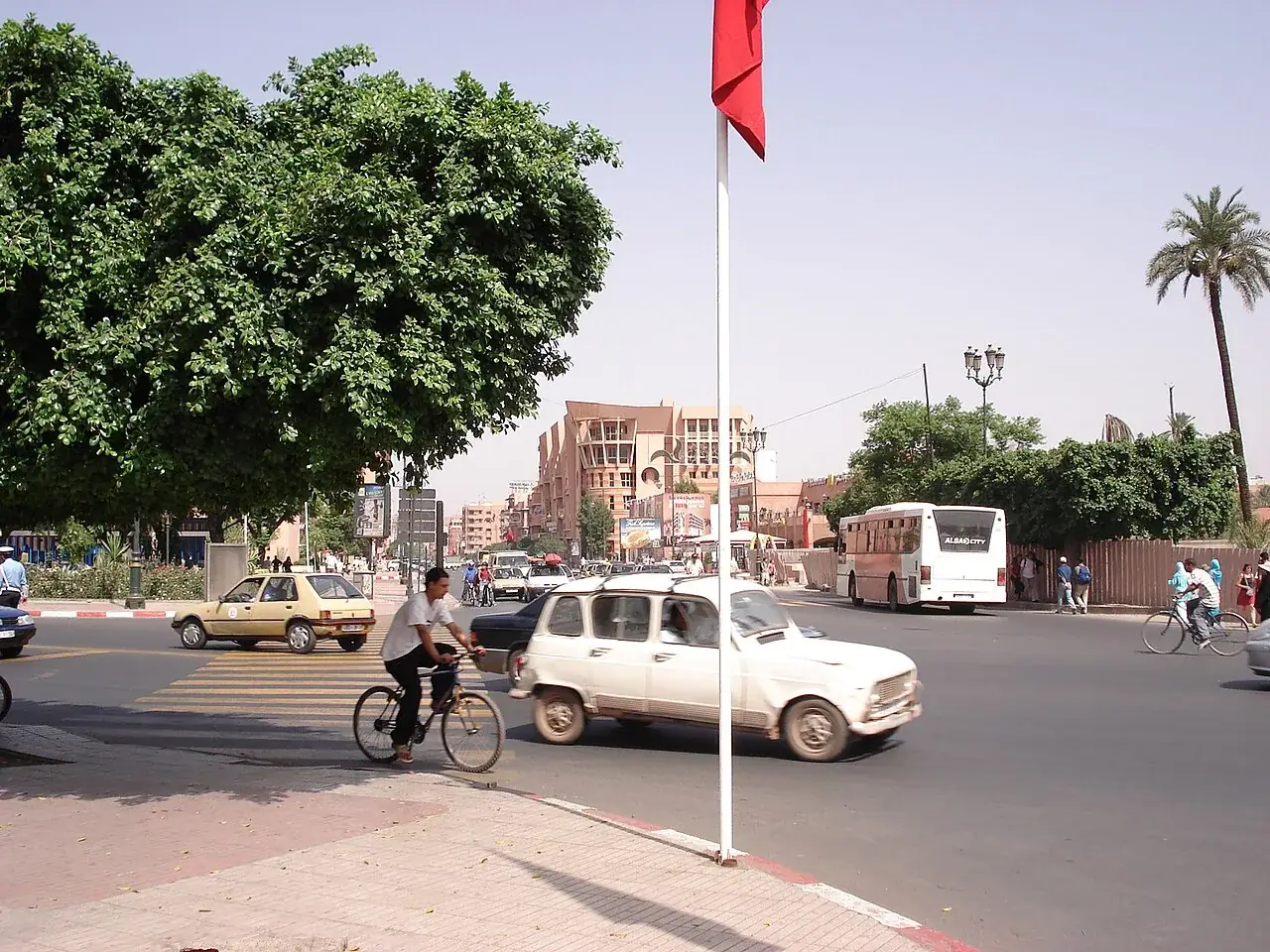
Begin at Place du 16 Novembre for a wide view of the new town's street layout. Walk a section of Avenue Mohammed V, then turn off it briefly instead of following the main road all the way back towards the medina. The scale change is the point: a wide road built to carry traffic gives way to shorter blocks where building outlines and balcony details become easier to see. The Fondation Guéliz's route is a good companion if architecture is the reason you came. It includes the square and Jnane El Harti. Look at the address before you follow a place name associated with a former building. A historic photograph is evidence of what stood there at the time.
2. Théâtre Royal and the railway station
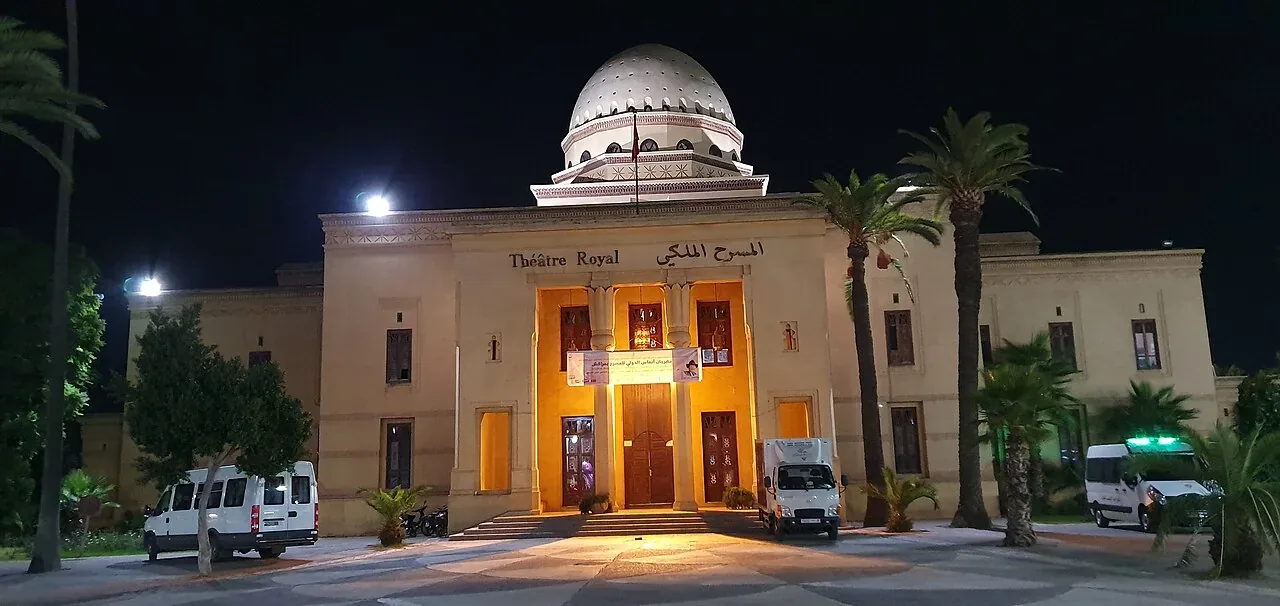
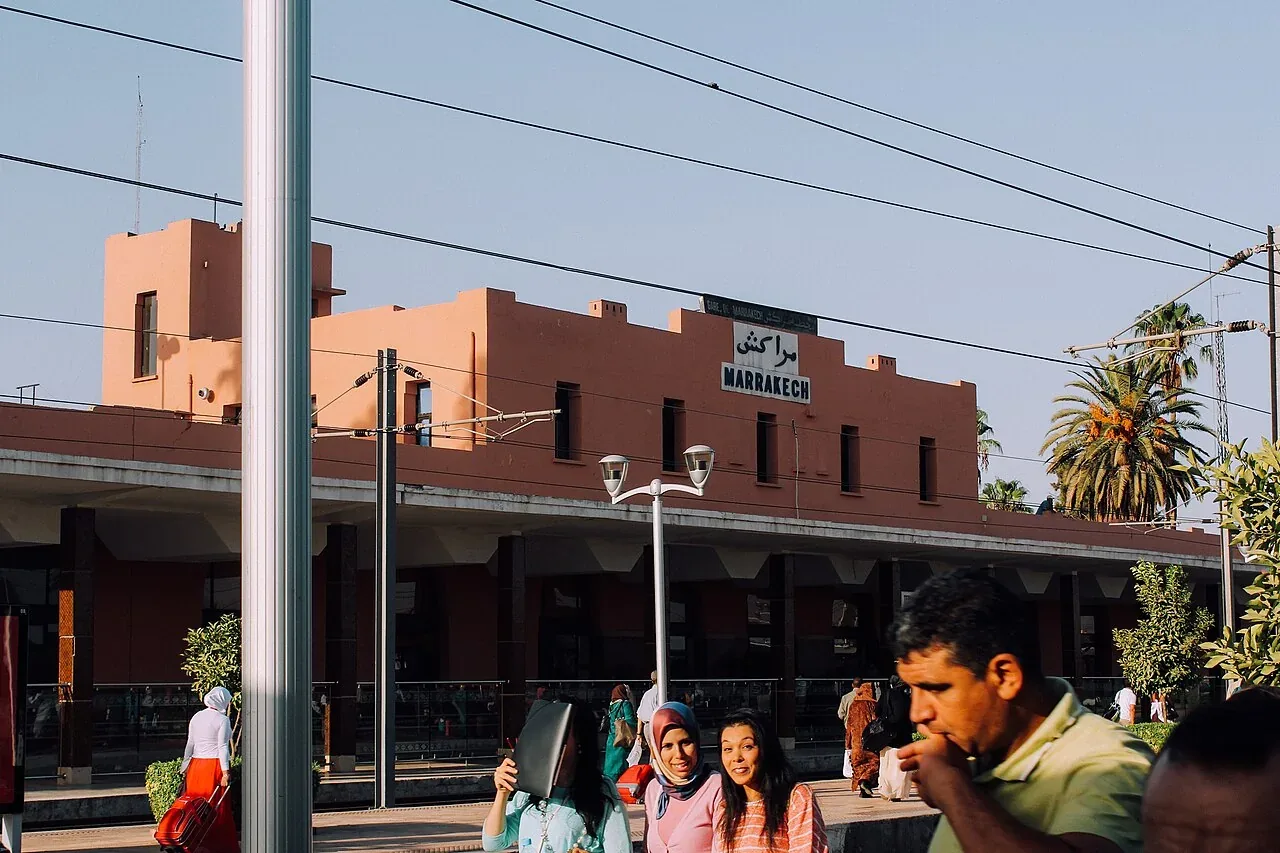
The theatre and station make a useful pair on the western side of the walk. Treat the theatre as an exterior stop unless you have confirmed an event or visiting slot. The station is a practical arrival point as well as another view of modern Marrakech. If you are arriving by rail, start here and walk towards the centre of Guéliz, then pick up the garden leg only if your timing allows. Use ONCF Voyages for current train times. If your train leaves the same afternoon, leave a buffer after the last stop rather than setting a museum booking right against departure.
3. Jnane El Harti
The park gives a natural break from the boulevard section. Put it between the station side and the main avenue when your arrival is flexible, or keep it as the only detour on a short walk without museum tickets. The fountain is an easy reference in older photographs. Treat access as subject to the gates and any local works on the day. If a gate is shut, a pause on the central part of the route is a better use of time than going around several blocks looking for an entrance. Keep the walk compact if you are travelling with children or have already spent the morning in the souks.
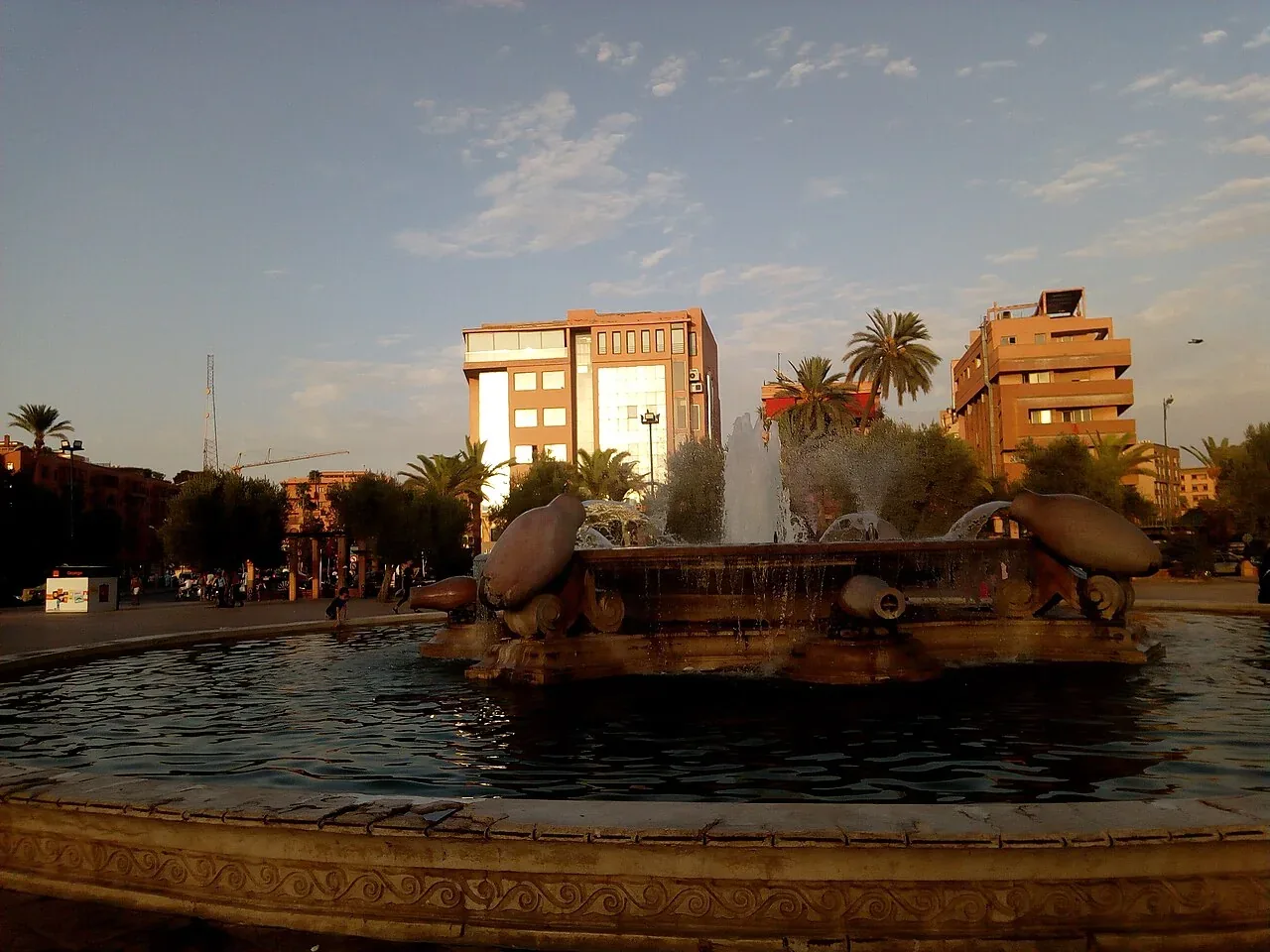
4. Jardin Majorelle
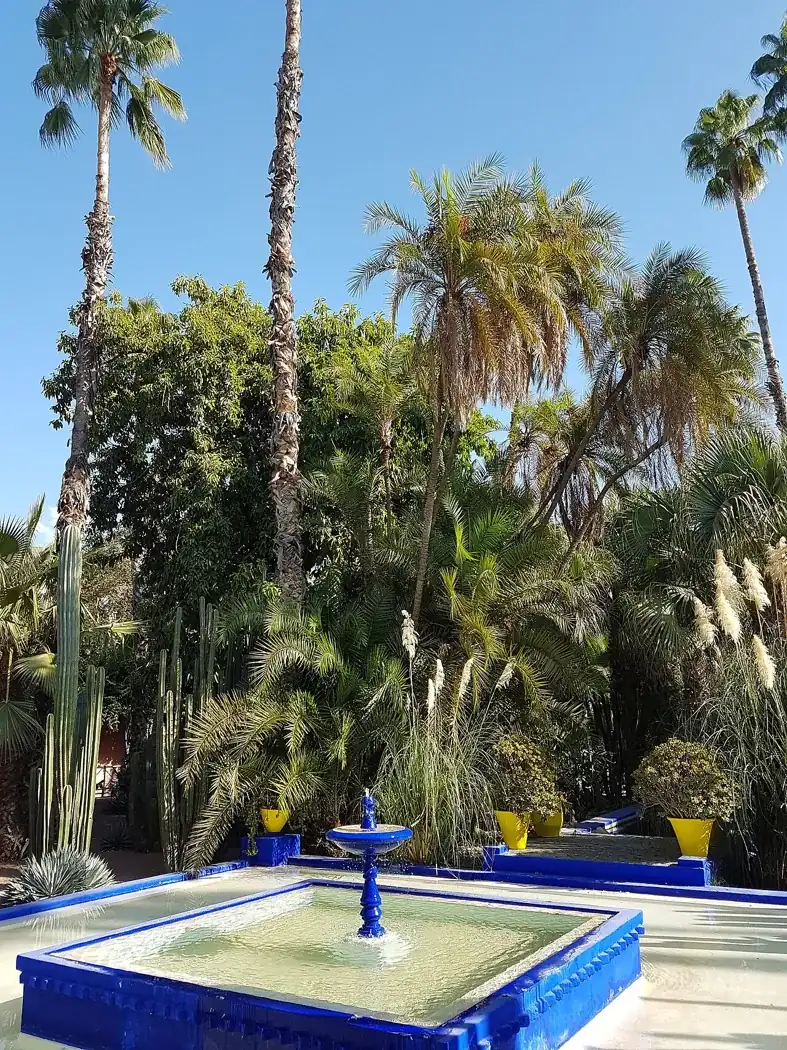
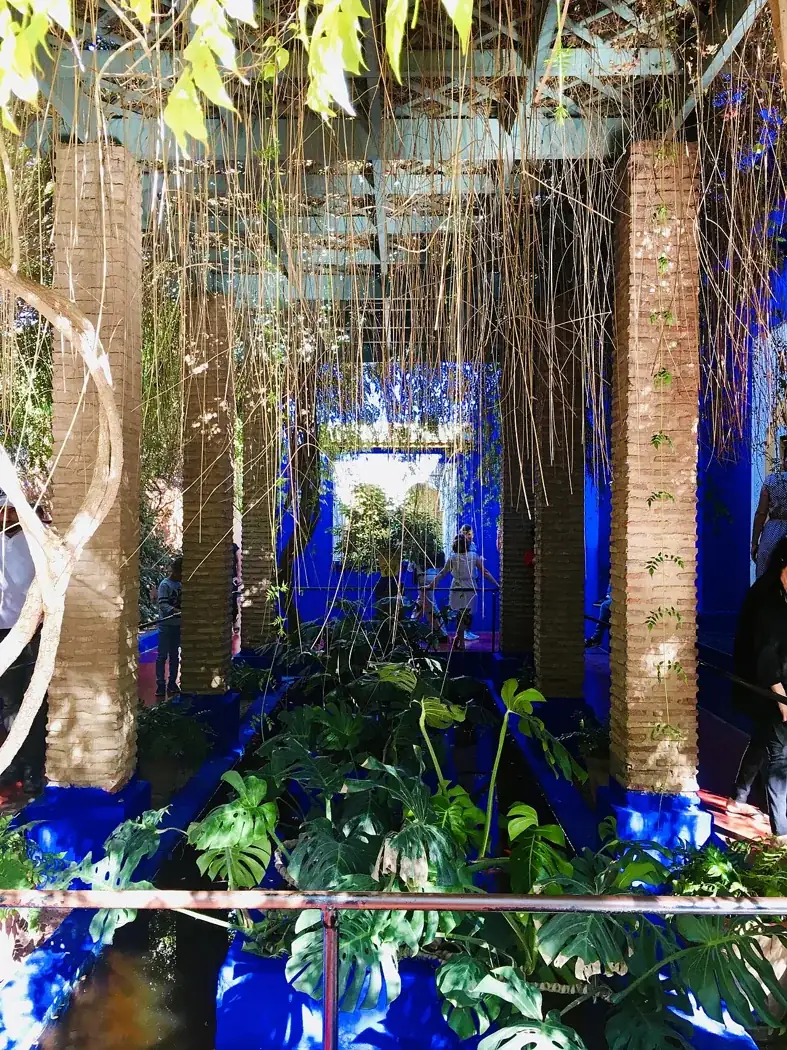
Don't miss this if you booked it: The garden adds a very different public space to the route. Its botanical collection, painted surfaces and water features are worth slowing down for. Look at how the planted paths change the view of the same blue from one turn to the next. The garden's official page currently lists 8 am to 6:30 pm daily, with last admission at 6 pm. Buy through its official ticket website in advance. Read exactly what the payment includes if you want the Berber Arts museum, Villa Oasis or the separate museum next door.
5. Musée Yves Saint Laurent Marrakech
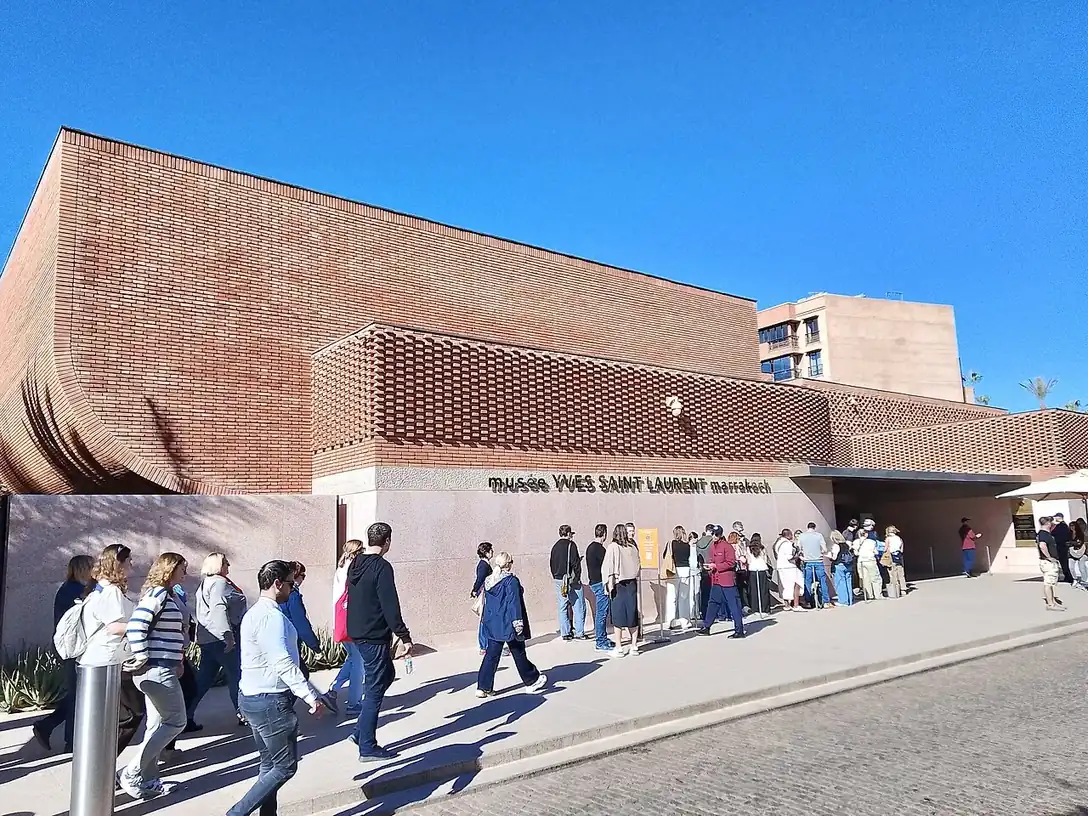
Save time for the museum if fashion, stage costume or exhibition design interests you. The brick exterior is on the same street as the garden entrance, which makes the pair easy to combine physically. The time problem is the admission schedule. Check the museum's current programme and confirm the closure day before building a morning around both. For a first trip where the garden is the main draw, use that as the fixed booking and choose the museum only if the exhibition and time fit. A garden visit followed by lunch in Guéliz is already a complete outing.
How to fit the walk into your day
Rail or hotel start: Walk from the railway station past the theatre exterior, pause by Jnane El Harti if access is open, then follow the streets towards Place du 16 Novembre. Choose a café or a side street from there. Finish at a booked garden slot or turn towards your hotel without adding a second district.
Early garden ticket: Go straight to the garden and keep the street walk for afterwards. It is easy to spend the best part of the morning between the garden and the museum. If those are your priorities, skip the station detour and spend the rest of your time around the square. For a day that also includes several monuments inside the walls, use the one-day Marrakech medina itinerary to decide what to save for tomorrow.
Late arrival or rain: Choose the museum if it is open and you can get a slot, or keep the outing to a café and a short run of streets. There is little reason to make repeated cross-town transfers to complete the list. For your first evening, a restaurant near your accommodation may be easier than adding Jemaa el-Fna immediately after a train or flight.
Save the garden QR code, the correct station pin and your return address before leaving your accommodation. If you want live directions between the garden and your hotel, check whether your phone supports an eSIM and whether you already have usable roaming.

Getting there and getting around
From the medina, it helps to choose a pick-up point a driver can reach, then specify your actual stop in Guéliz. Place du 16 Novembre and Rue Yves Saint Laurent are different destinations. On arrival days, our Marrakech airport transfer guide explains how to match an arrival option to your accommodation. The Marrakech neighbourhood and hotel guide is more useful for deciding whether to sleep in Guéliz or spend the night inside the walls.
For the route on foot, leave time at crossings and use the streets that have the easiest pavements on the day. A more direct route on a map may send you along a wider road at its busiest point. In warm weather make the longer outdoor section early. In winter, keep an extra layer for pauses after sunset. Use the Marrakech travel guide to match this half day to the rest of the city.
Three small choices that save time
- Decide which entrance you need. Two neighbouring ticketed venues can have different hours, ticket types and queues.
- Look above the shop signs. The avenue is useful for orientation. Side streets and upper façades are better for noticing the architecture.
- Use the station as an end point if you have luggage. It makes the walk much easier to shorten if a train time or the weather changes.
Book the fixed-hour visit first. Everything else in Guéliz can fit around it.
Frequently asked questions about Guéliz
Is Guéliz in the Marrakech medina?
Guéliz is in the newer city outside the medina walls. Avenue Mohammed V is a useful way to orient yourself between the districts.
Is Guéliz worth visiting on a first trip?
Yes if you want the garden, museum, architecture or a slower café stop. With one full day, prioritise whichever part of Marrakech interests you most and choose your route around it.
How long should I spend in Guéliz?
Allow roughly three to four hours for an unhurried walk and one ticketed venue. Add time if you want the garden and fashion museum together.
Can I buy a Jardin Majorelle ticket at the gate?
The operator directs visitors to buy online. Use the official ticket site and check your date, entry time and included venues before paying.
Can I start the walk at Marrakech railway station?
Yes. Begin at the station, pass the Théâtre Royal exterior and continue towards Jnane El Harti and Place du 16 Novembre. Make the garden detour only if it fits your arrival or departure time.
Do I need a guide for Guéliz?
The main stops work well independently. If your interest is architecture, start with the Fondation Guéliz walking material and leave enough time to look beyond the main road.
Continue with things to do in Marrakech for other half days, including those within the medina.
Photo credits
- Traffic crossing Place de la Liberté in Guéliz, with palms and the fountain across the road. Draceane / Wikimedia Commons, CC BY-SA 4.0 (licence). Resized and converted to WebP.
- Traffic, pavements and a Moroccan flag along Avenue Mohammed V in an archival Guéliz photograph. mwanasimba from La Réunion / Wikimedia Commons, CC BY-SA 2.0 (licence). Resized and converted to WebP.
- The Théâtre Royal in Marrakech illuminated at night. Yair Haklai / Wikimedia Commons, CC BY-SA 4.0 (licence). Resized and converted to WebP.
- The platform side of Marrakech railway station, with travellers and overhead lines. Stolbovsky / Wikimedia Commons, CC BY-SA 4.0 (licence). Resized and converted to WebP.
- The fountain at Jnane El Harti, photographed from inside the park. Zahra IMEHLI / Wikimedia Commons, CC BY-SA 4.0 (licence). Resized and converted to WebP.
- Water and planting around a blue-edged pool at Jardin Majorelle. Ciell / Wikimedia Commons, CC BY-SA 4.0 (licence). Resized and converted to WebP.
- Visitors outside the brick Yves Saint Laurent museum in Marrakech. Pivari / Wikimedia Commons, CC BY 4.0 (licence). Resized and converted to WebP.
- Trees reflected in a channel beside a blue wall in Jardin Majorelle. Irenea02 / Wikimedia Commons, CC BY-SA 4.0 (licence). Resized and converted to WebP.
Photo credits
- Traffic crossing Place de la Liberté in Guéliz, with palms and the fountain across the road · Draceane / Wikimedia Commons, CC BY-SA 4.0; resized and converted to WebP
- Traffic, pavements and a Moroccan flag along Avenue Mohammed V in an archival Guéliz photograph · mwanasimba from La Réunion / Wikimedia Commons, CC BY-SA 2.0; resized and converted to WebP
- The Théâtre Royal in Marrakech illuminated at night · Yair Haklai / Wikimedia Commons, CC BY-SA 4.0; resized and converted to WebP
- The platform side of Marrakech railway station, with travellers and overhead lines · Stolbovsky / Wikimedia Commons, CC BY-SA 4.0; resized and converted to WebP
- The fountain at Jnane El Harti, photographed from inside the park · Zahra IMEHLI / Wikimedia Commons, CC BY-SA 4.0; resized and converted to WebP
- Water and planting around a blue-edged pool at Jardin Majorelle · Ciell / Wikimedia Commons, CC BY-SA 4.0; resized and converted to WebP
- Visitors outside the brick Yves Saint Laurent museum in Marrakech · Pivari / Wikimedia Commons, CC BY 4.0; resized and converted to WebP
- Trees reflected in a channel beside a blue wall in Jardin Majorelle · Irenea02 / Wikimedia Commons, CC BY-SA 4.0; resized and converted to WebP