

Short answer — Chefchaouen is worth one night, not three. The medina is small; you can walk its length in an afternoon. What changes is the evening, after the day-trip coaches leave around 16:00. Get there from Tangier on the CTM bus for 50–80 MAD in about 2 h 30, five departures a day; from Fes it is roughly 2 h 35. Budget 60 MAD for the Kasbah, the only paid entry in town, and nothing for the Spanish Mosque viewpoint. Come between March–May or September–November, when days sit at 18–27 °C. Pack something warm regardless: January nights drop to 6 °C and most riads have no heating.
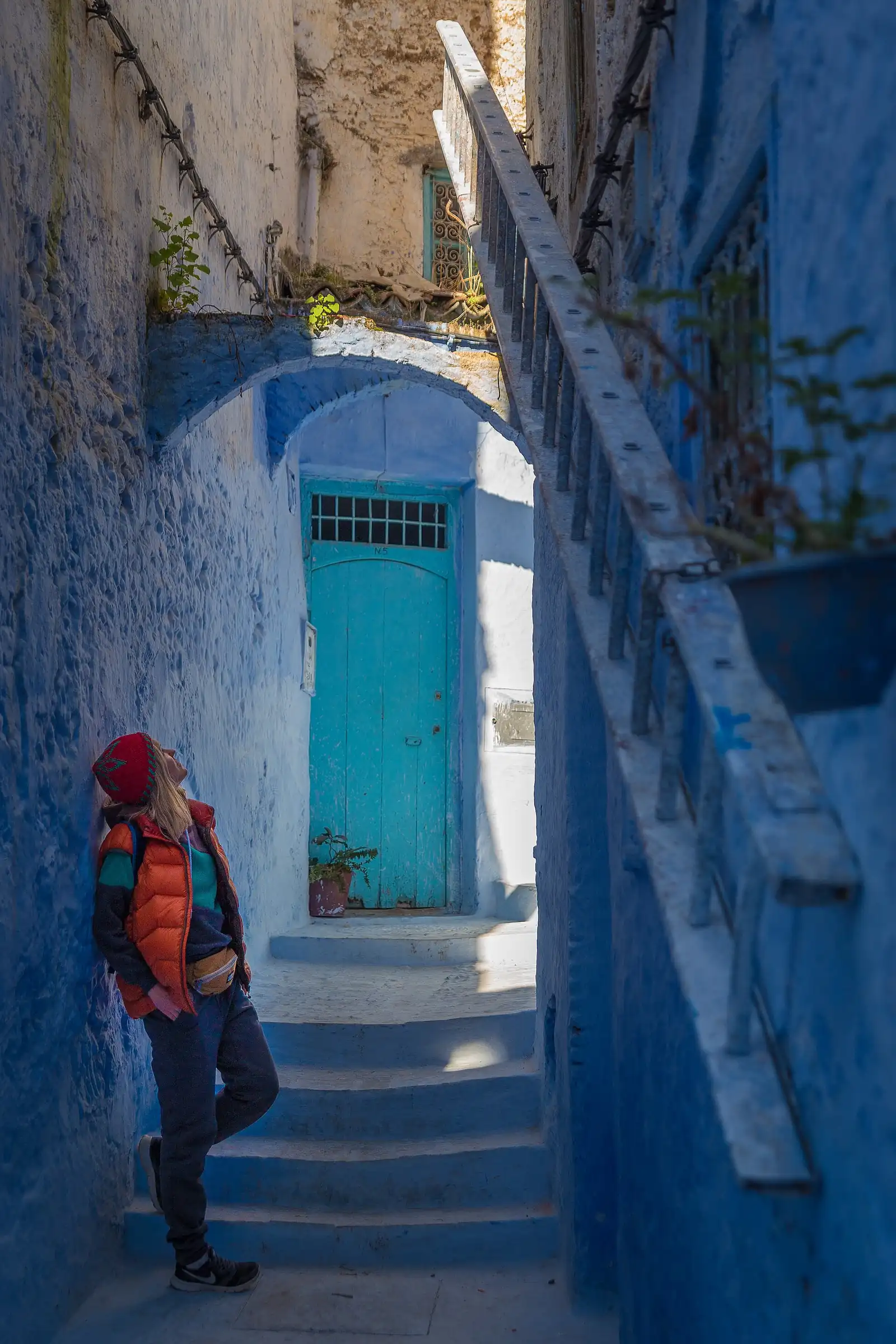
Chefchaouen is the most photographed small town in Morocco and one of the least understood. Almost every guide tells you to slow down and stay a while. Having watched the rhythm of the place, I think that advice is half right and half copied from the last guide.
The town rewards an overnight. It does not reward three. This guide explains where that line falls, what it costs, and what changes between four in the afternoon and eight in the evening — because that gap is the entire argument for sleeping here.
Why the town is blue
Three explanations circulate, and they are not equally supported.
The most repeated one credits the Jewish community that settled here after fleeing Spain, for whom blue carried religious meaning. The second says the paint repels mosquitoes — physically dubious, and the version most often told to visitors. The third is the least romantic and the most visible: blue sells. The wash is refreshed constantly because the town’s economy now runs on people photographing it.
What you can see for yourself is that the blues do not match. Every household repaints its own stretch of wall, in its own year, with its own mix. Stand in one alley and count the shades — there will be four or five. That patchwork is the giveaway that this is a living town maintaining itself, not a film set painted in one pass.
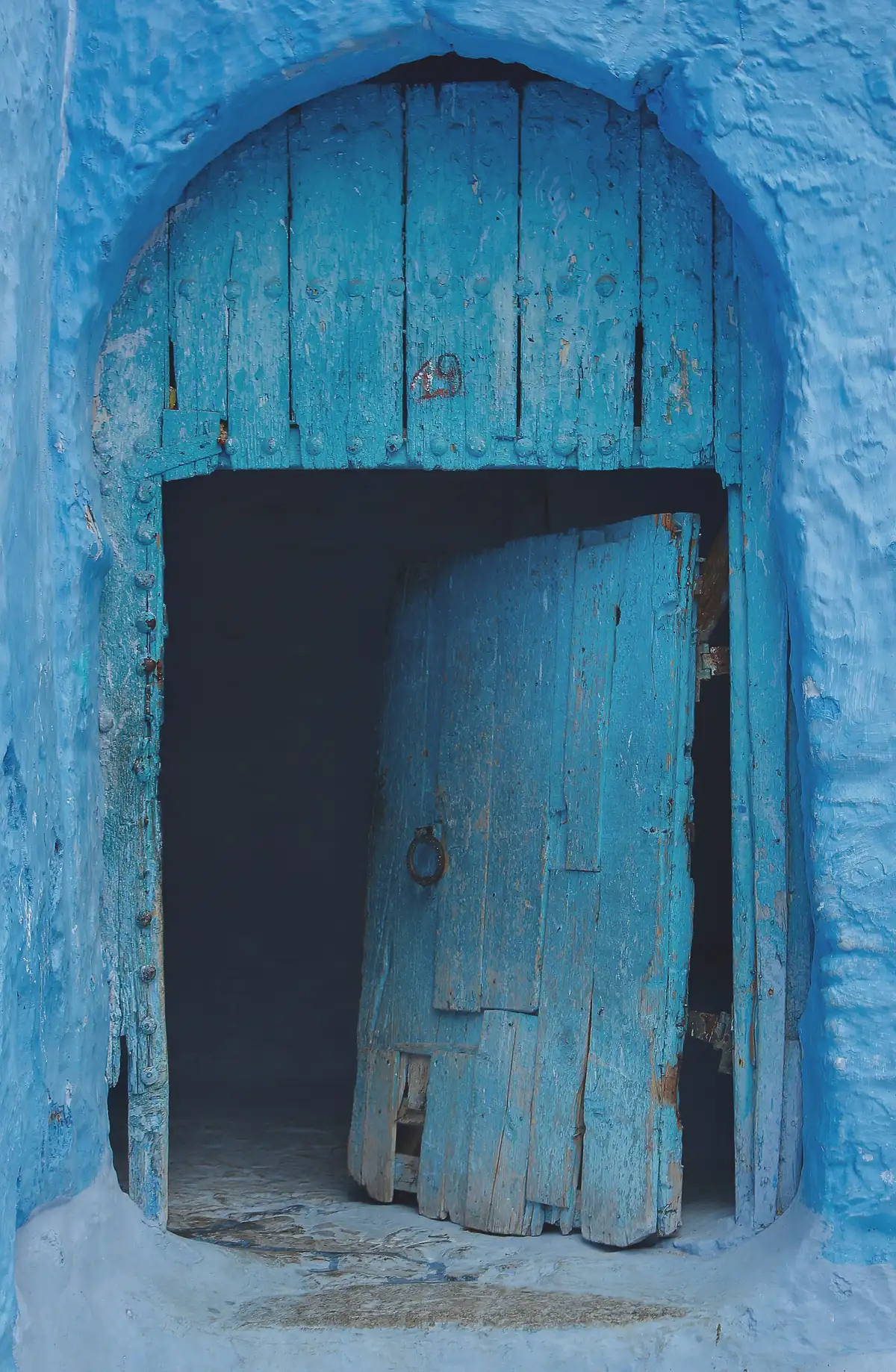
The full account, with what the sources actually say and what the town’s own residents say, is in our guide to why Chefchaouen is blue.
How long to stay — the honest answer
One night. Two days. That is the shape that works, and here is the reasoning rather than the platitude.
A day trip from Tangier or Fes is genuinely fine for most people. You will see the medina, climb to a viewpoint, eat well, and leave having got what you came for. Anyone telling you a day trip is a waste is selling you a hotel night.
But the coaches arrive late morning and leave around four. Between four and eight the town returns to itself: the main square fills with families rather than tour groups, shopkeepers stop performing, and the light on the western walls goes from flat to extraordinary. That two-hour window is what you are buying with an overnight, and it is worth buying.
What a third night buys you is very little, unless you are hiking. The medina is not large enough to sustain three days of wandering, and by the second afternoon you will have walked every lane twice. If you have the time, spend it at Akchour rather than in the town.
The line: day trip if you are short on time and want the photographs. One night if you want the town. Two nights only if you are walking to the waterfalls.
Getting there from Tangier, Fes and Marrakech
Chefchaouen has no airport and no train. Every arrival is by road, and the road is the part people underestimate.
| From | Best option | Price | Time | Frequency |
|---|---|---|---|---|
| Tangier | CTM bus | 50–80 MAD | 2 h 15 – 2 h 30 | 5 a day |
| Fes | CTM bus | ≈ 100 MAD | ≈ 2 h 35 direct; longer via Ouazzane | Several a day |
| Marrakech | Don’t. Fly or train to Tangier or Fes first | — | 10 h+ overland | — |
Prices checked August 2026. CTM publishes its timetable online and seats sell out on weekends and in high season — book the day before rather than turning up.
Tangier is the easiest gateway. Five CTM departures a day, a two-and-a-half hour run through the Rif, and a fare that has stayed in the 50–80 MAD band. If you are arriving in Morocco by ferry from Spain, Chefchaouen is the logical first stop rather than an add-on.
From Fes it is a similar journey time but fewer good departures, and some services route through Ouazzane with a change. Check whether your ticket is direct before you buy — the indirect version turns a comfortable morning into most of a day.
From Marrakech, do not attempt it overland. Ten hours each way to see a town you can cross in an afternoon is a bad trade. Fly or take the train north, see Tangier or Fes properly, and treat Chefchaouen as part of that trip. Our Tangier travel guide and Fes travel guide both work as the anchor for that route.
Getting to Chefchaouen without the bus The CTM is cheap and slow. If you are arriving from Tangier or Fes with luggage, or landing late, a private transfer removes the connection entirely.
Affiliate disclosure: CityQuest Morocco may earn a small commission if you book through these links — at no extra cost to you. We only link to operators we’d use ourselves.
Full timetables, grand-taxi options and where each bus station actually is: how to get to Chefchaouen.
What to actually do
The Kasbah — 60 MAD, and the only ticket you need
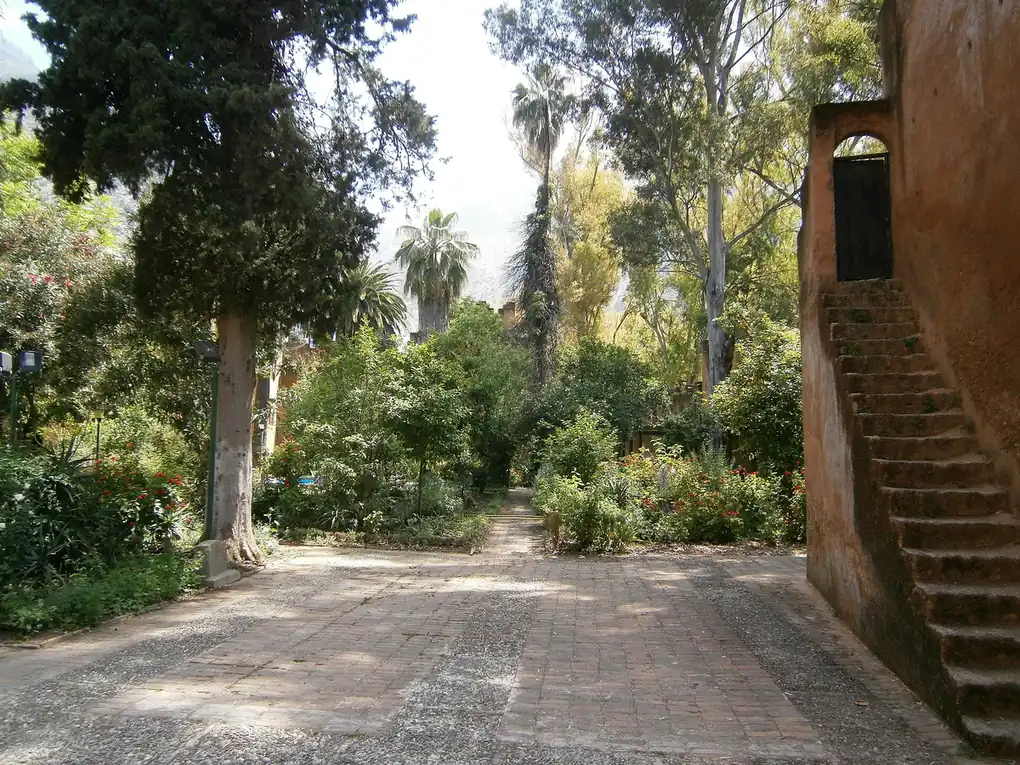
The Kasbah sits on Place Outa el-Hammam, open 09:00 to 18:00, entry 60 MAD. Inside there is an Andalusian garden, a small museum, and a tower.
Go up the tower. It is the cheapest way to get above the rooftops, and unlike the Spanish Mosque it does not cost you a climb. Twenty minutes is enough for the whole thing unless the museum grabs you.
Place Outa el-Hammam — where everything ends up
The main square, ringed with café terraces under the Kasbah walls. Every walk through the medina funnels back here eventually, which makes it the natural place to eat and the natural place to sit at dusk when the day-trippers have gone.
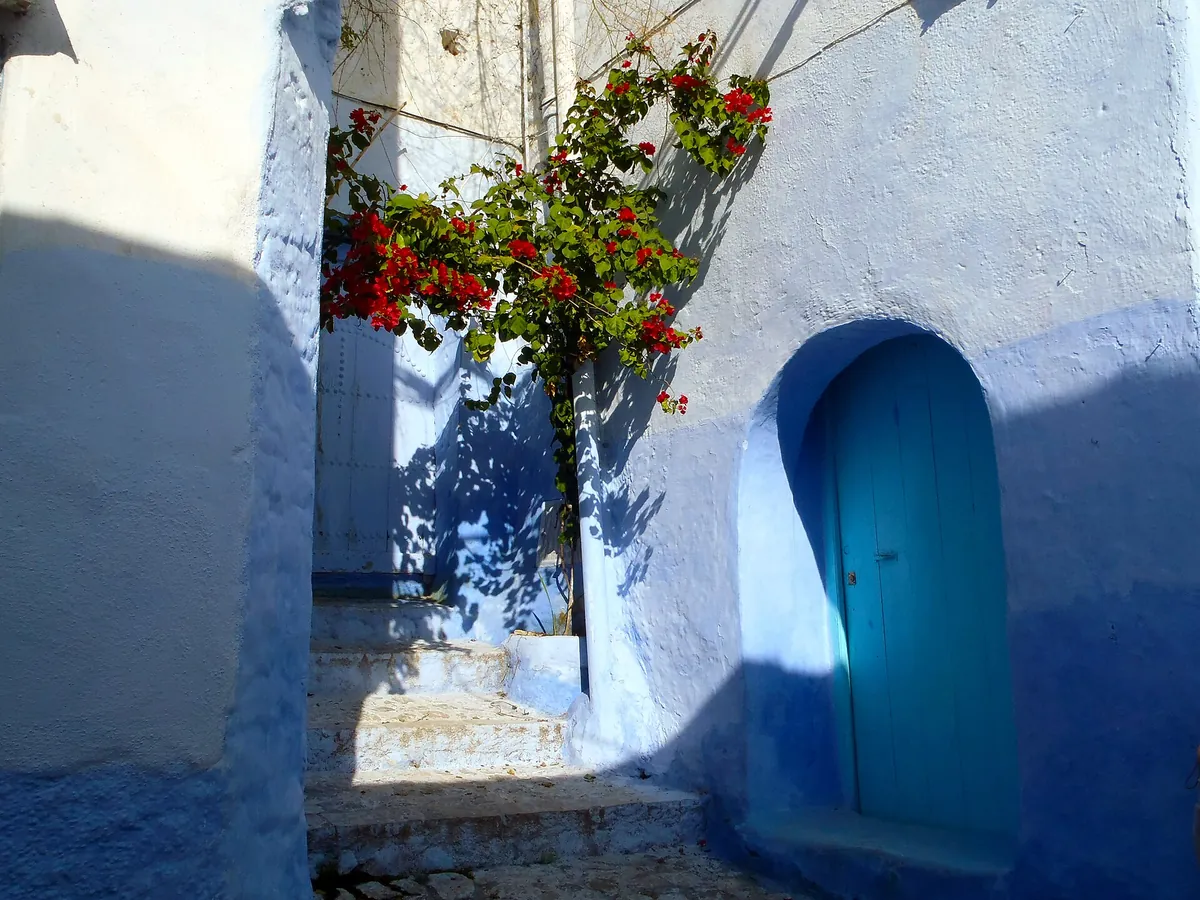
The Spanish Mosque — free, and somewhere between 20 and 45 minutes uphill
This is the shot everyone comes for: the whole blue medina below you, best in the last hour before sunset. There is no entry fee.
On the walk up, published times range from twenty minutes to forty-five. That spread is not sloppy writing — it depends on where in the medina you start and how you handle a steady climb. From the eastern edge, near Ras el-Maa, a reasonably fit walker does it in about twenty-five minutes. From the far western side of the medina, add fifteen.
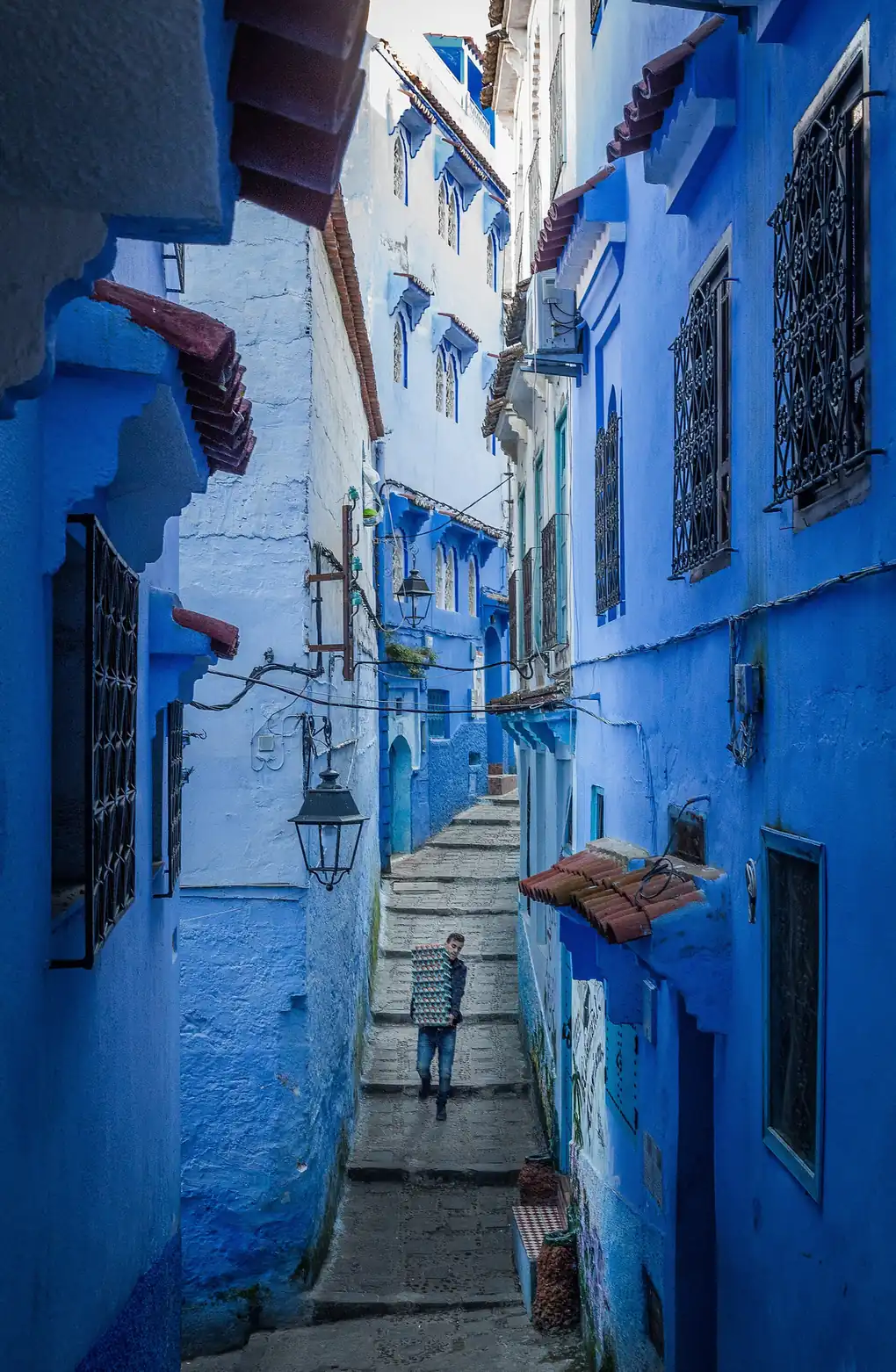
Ras el-Maa — the spring that put the town here
On the eastern edge, where the water comes out of the mountain. The washing terraces are still used every morning. It is a five-minute walk from the medina edge and it is also the start of the path up to the Spanish Mosque, so the two combine naturally.
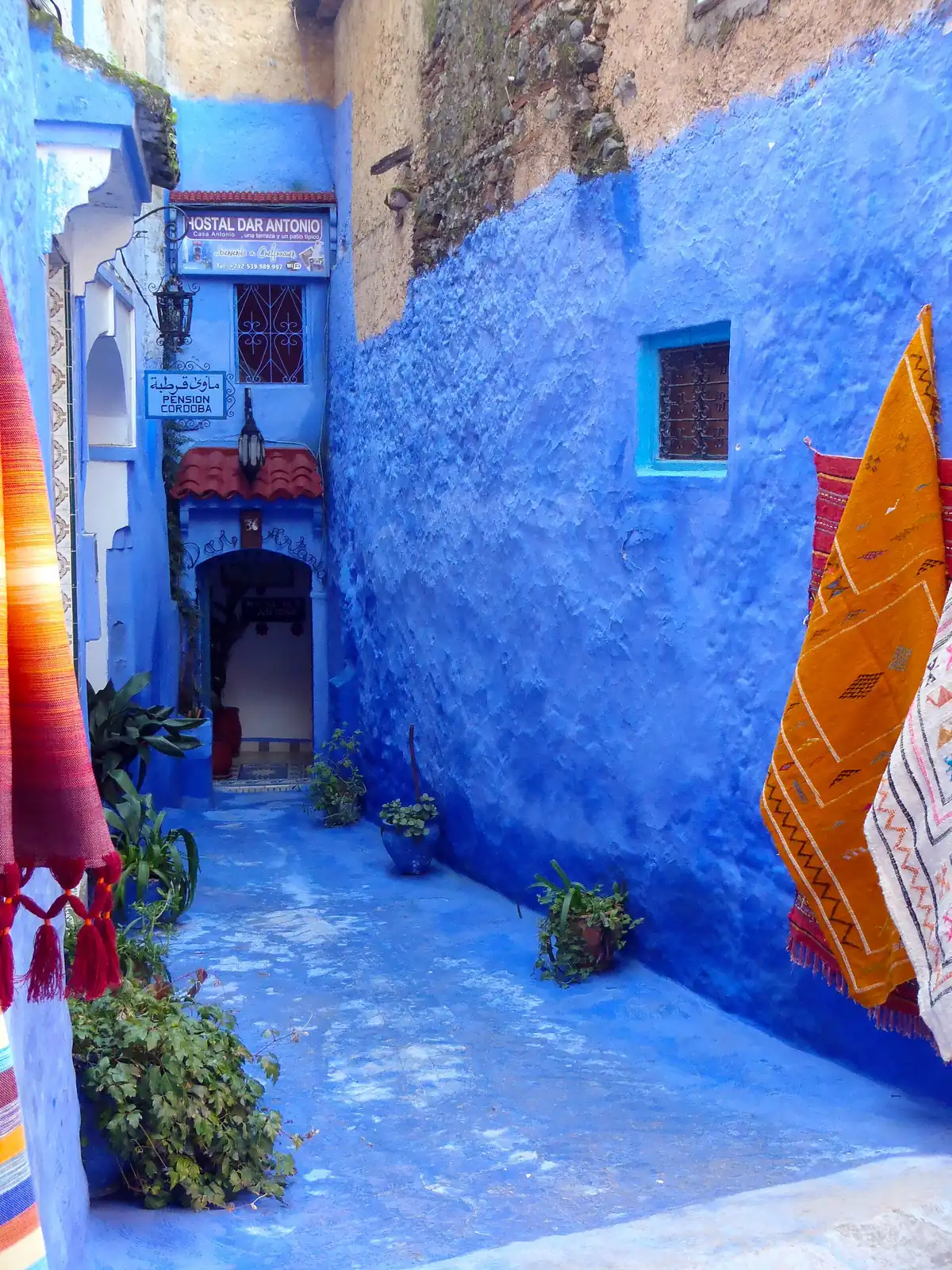
Bab el-Ain and the lanes
Come in through Bab el-Ain and the blue begins within twenty paces. Beyond that, the honest advice is to stop navigating. The medina is small enough that getting lost costs you nothing — you will hit a wall or the square within ten minutes in any direction.
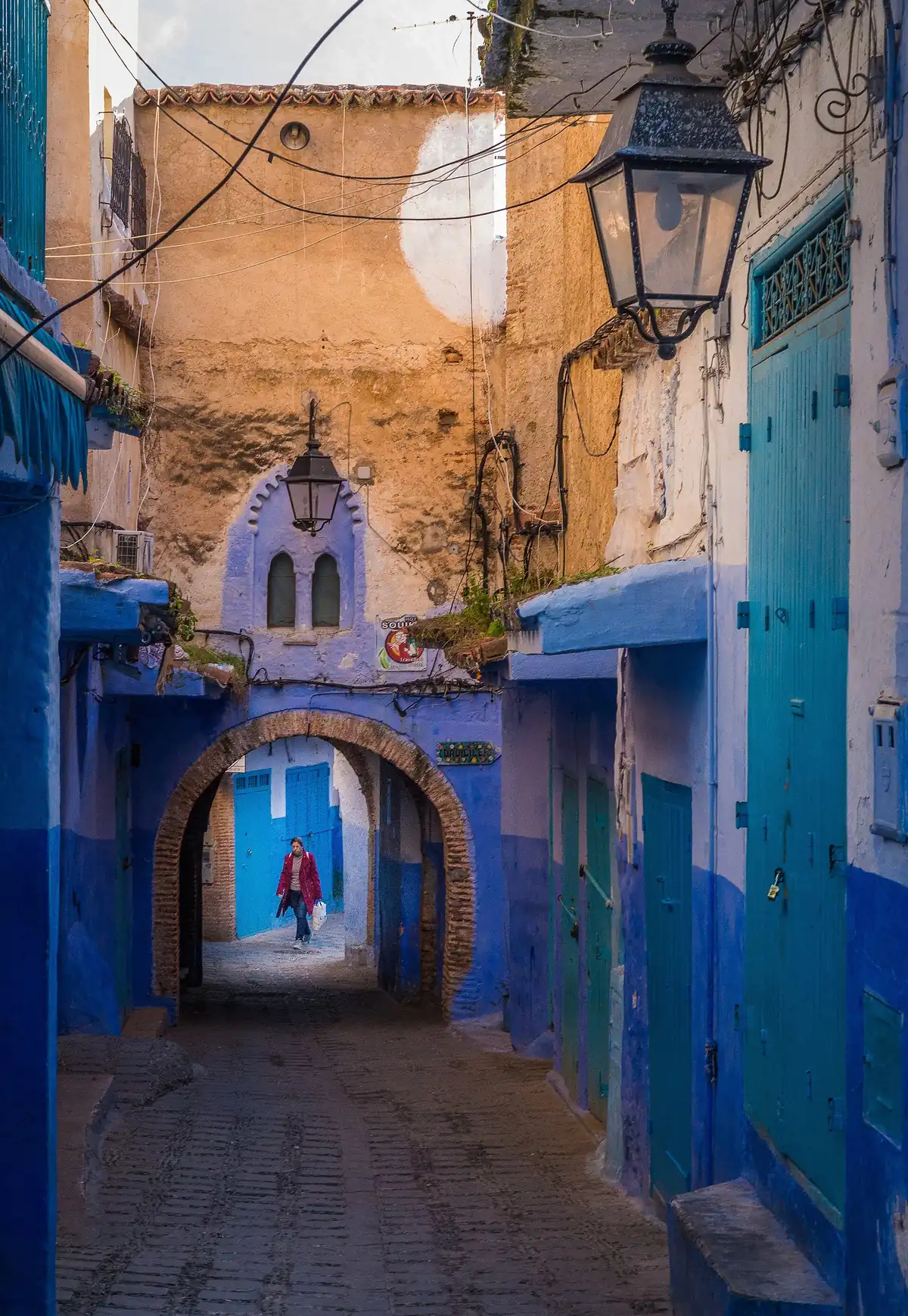
The full list, with the two photo spots most visitors miss: things to do in Chefchaouen.
Where to stay
Four areas, and the choice matters more than in a bigger city because the town is built on a slope.
- Inside the medina — the reason you came. Blue lanes at the door, the evening atmosphere on tap. Trade-off: no car access, and everything is up or down.
- Around Place Outa el-Hammam — most convenient for eating and for that dusk hour. Noisier, and the terraces run late.
- Near Bab el-Ain — the compromise. A minute from the medina, reachable with luggage without a climb.
- Outside the walls, towards the Spanish Mosque — quieter, better views back at the town, a ten-minute walk in.
Neighbourhood-by-neighbourhood picks with prices: where to stay in Chefchaouen.
Map: the medina, Place Outa el-Hammam, the Kasbah, Ras el-Maa, Bab el-Ain and the path to the Spanish Mosque.
When to go
| Season | Day | Night | Verdict |
|---|---|---|---|
| Mar–May | 18–26 °C | Cool | Best. Wildflowers on the Rif slopes, doorway geraniums at their peak |
| Jun–Aug | up to 32 °C | 19 °C | Hot and busiest. July is the driest month |
| Sep–Nov | 20–27 °C | Cool | Excellent. Softer light, thinner crowds. November turns wet |
| Dec–Feb | 15 °C | 6 °C | Cold, wet, cheap and empty. December is the wettest month |
The comfortable window is March to May and September to November. Both shoulder seasons beat summer on every measure except swimming, and there is nowhere to swim.
Planning around the wider country’s seasons? See Morocco in April.
Akchour — the reason to give it a second day
Half an hour east, in the Talassemtane hills, a river runs through a gorge with a series of pools and cascades and a rock arch the guides call God’s Bridge. It is the one thing near Chefchaouen that genuinely needs a full day, and it is the only good reason to stay two nights rather than one.
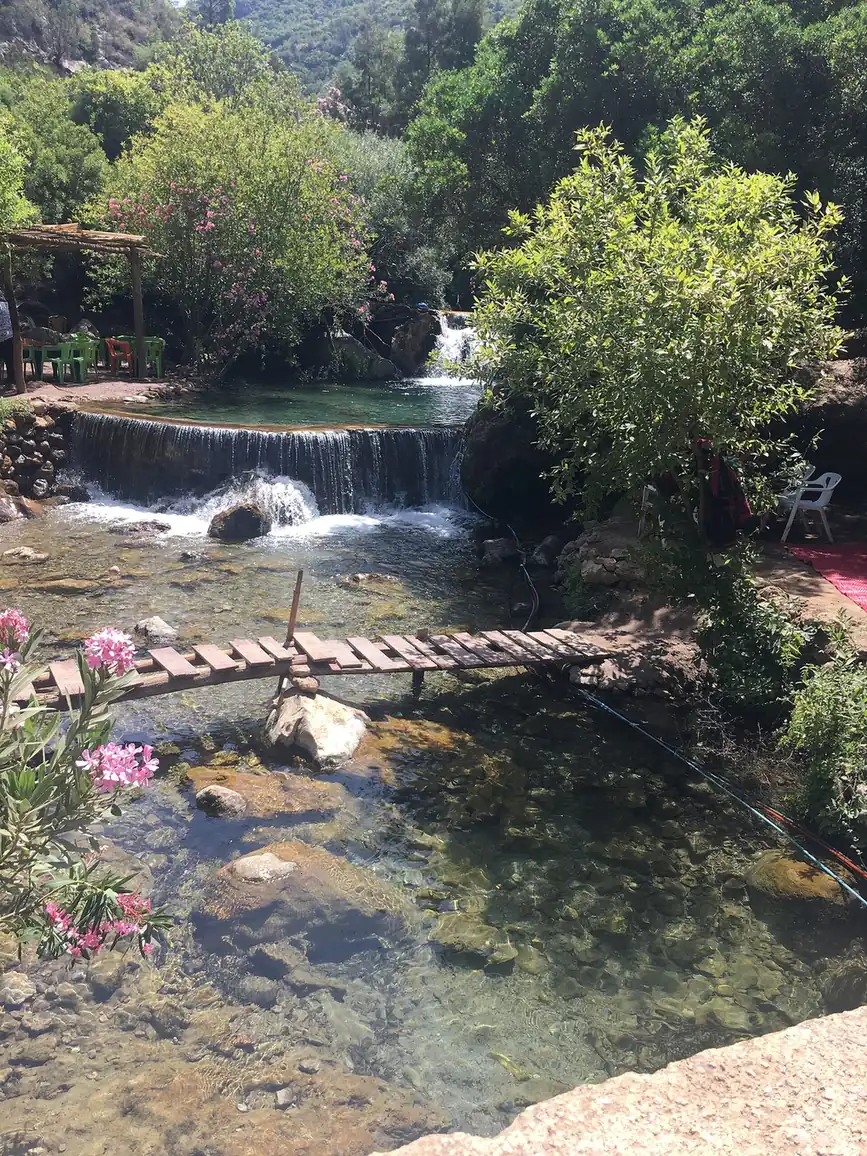
Go early. The pools fill up by midday in summer and the walk in is exposed.
What it costs
| Item | Price (Aug 2026) |
|---|---|
| CTM bus, Tangier → Chefchaouen | 50–80 MAD |
| CTM bus, Fes → Chefchaouen | ≈ 100 MAD |
| Kasbah museum entry | 60 MAD |
| Spanish Mosque viewpoint | Free |
| Ras el-Maa | Free |
Accommodation and meal prices move with the season and are covered, with current ranges, in the where to stay guide.
Who should skip Chefchaouen
Most guides will not tell you this, so here it is plainly. There are people for whom this town is a poor use of two travel days.
- If you have under a week in Morocco. Chefchaouen is a long way from everything. A week is enough for one imperial city, the desert, or the coast — not for a detour to the far north.
- If you are based in Marrakech. Ten hours overland each way, for a town you can cross in an afternoon. The maths does not work.
- If you came for monuments. There is one paid site, and it takes twenty minutes. Fes and Marrakech will give you a hundred times the built heritage.
- If you struggle with slopes. The town is built on a mountainside. There is no flat route through the medina, and the cobbles are uneven.
Everyone else: go. Just go for one night.
Safety, etiquette, and the one thing to say no to
Chefchaouen is one of the calmer places in Morocco. The hassle level is well below Marrakech or Fes, serious crime against visitors is rare, and solo women generally report feeling comfortable walking the medina. The annoyances here are touts, not danger.
The one exception is worth stating clearly. The Rif is Morocco’s cannabis-growing region, and in Chefchaouen you will be approached — often within hours of arriving, and repeatedly. Recreational cannabis remains illegal in Morocco. A 2021 law legalised industrial and medical production only; recreational possession is still a criminal offence.
Do not buy from a street approach. Setups involving plainclothes officers are a documented tactic, and the realistic outcome for a foreigner is not a court case but sustained pressure for a large cash payment. A firm, polite “no, thank you” and continuing to walk ends the conversation. If you are walking in the hills, do not photograph cultivated fields or the people working them.
On photography generally: the walls, doors and lanes are fair game, and residents are used to it. People are not. Ask before pointing a camera at anyone, and accept a refusal — particularly with women. It costs you one shot and buys the next visitor a better welcome.
On dress: this is a conservative mountain town, more so than Marrakech. Covered shoulders and knees are the comfortable default for everyone, and it is a courtesy that gets noticed here in a way it does not in a resort.
One more practical thing: Spanish is more useful than French in the far north. Chefchaouen sat under Spanish administration, and older residents will often switch to Spanish before French. If you have a little of either, lead with Spanish here.
What nobody tells you
- The nights are genuinely cold. The town sits up in the Rif, not on the coast. January nights hit 6 °C and most riads have no heating — people pack for “Morocco” and spend the evening in a jacket indoors.
- The blues do not match, and that is the point. Each household repaints its own stretch. Counting the shades in a single alley is the fastest way to tell a lived-in town from a decorated one.
- The Spanish Mosque descent is unlit. Every guide sends you up there for sunset. None mentions that you come down in the dark, on a rough path. Take a torch or start down while there is still light in the sky.
- Four in the afternoon is the hinge. The day-trip coaches leave, and within an hour the town is a different place. If you are only here for the day, plan to leave on the last bus rather than the convenient one.
- The Kasbah tower beats the hike if your knees object. 60 MAD gets you above the rooftops with no climb. It is not the same view, but it is a view, and it is a hundred metres from a café.
Want to walk it as a game? Our Marrakech quests turn a medina walk into a treasure hunt with clues, GPS stops and a certificate at the end. A Chefchaouen quest is in development — try the Marrakech Souks Quest in the meantime.
Frequently asked questions
Is Chefchaouen worth visiting?
Yes, for one night. The medina is genuinely beautiful and unlike anywhere else in Morocco, and the evening — once the day-trip coaches have gone — is the part worth travelling for. It does not sustain three days unless you are hiking to Akchour.
Can you do Chefchaouen as a day trip?
From Tangier or Fes, yes, and for most visitors it is a perfectly good option. You get the medina, a viewpoint and a meal. What you miss is the evening. If you can only do a day trip, take the latest return bus rather than the middle-of-the-afternoon one.
How do you get to Chefchaouen?
By road only — there is no airport and no train. CTM runs five buses a day from Tangier (50–80 MAD, about 2 h 30) and several from Fes (roughly 2 h 35 direct). From Marrakech, travel north to Tangier or Fes first rather than attempting it overland.
How much does the Kasbah cost?
60 MAD, open 09:00 to 18:00. It is the only paid entry in the town. The Spanish Mosque viewpoint and Ras el-Maa are both free.
What is the best time to visit Chefchaouen?
March to May, or September to November. Days sit between 18 and 27 °C. Summer reaches 32 °C and is the busiest period; December is the wettest month and January nights fall to 6 °C.
Why is Chefchaouen blue?
Three explanations circulate: a Jewish tradition brought from Spain, a belief that blue repels mosquitoes, and the plain fact that the colour now draws visitors. The uneven shades across neighbouring walls show the paint is maintained house by house rather than applied in one campaign.
How long is the walk to the Spanish Mosque?
Between 20 and 45 minutes depending on where you start and how you take a steady climb. From the eastern edge near Ras el-Maa, allow about 25 minutes. It is free, and the descent afterwards is unlit.
Where to go next
Chefchaouen sits naturally in a northern loop. Pair it with Tangier for the ferry arrival and the Strait, or with Fes for the medina contrast — two hours apart and about as different as two Moroccan cities get.
- Where to stay in Chefchaouen — by neighbourhood, with prices
- How to get to Chefchaouen — timetables and grand-taxi options
- Things to do in Chefchaouen — including the two photo spots most people miss
- Why Chefchaouen is blue — the three theories, weighed
- Morocco in April — if you are timing the wider trip
📱 Stay connected in Morocco
Get a Morocco eSIM before you fly — instant activation, no roaming, around €5–15.
Affiliate link.
Some links on this page are affiliate links. If you book through them we may earn a commission at no extra cost to you. It never changes what we recommend — we have no commercial relationship with any riad or bus operator in Chefchaouen.